Rooflights that open
Fresh air through the roof
A rooflight that opens does a job no wall window can: it lets the warmest air in the house out at the very top. This page explains how that works, which way of opening suits which room, and where a fixed pane still wins.
Why the top of the house matters
Heat and moisture go up. Cooking steam, shower vapour, the warmth of a sunny afternoon and the breath of a sleeping household all drift towards the roof. In a typical Bristol terrace or 1930s semi, they end up on the top landing and in the loft room, which is why those spaces feel close long after the rest of the house has cooled.
An opening at the highest point gives that air an exit. Once it leaves, lower windows and doors become the way in, and air moves up through the house of its own accord. The effect has a name, the stack effect, and it works best when the top opening is as high as you can get it and there is a clear path from the ground floor up the stairs.
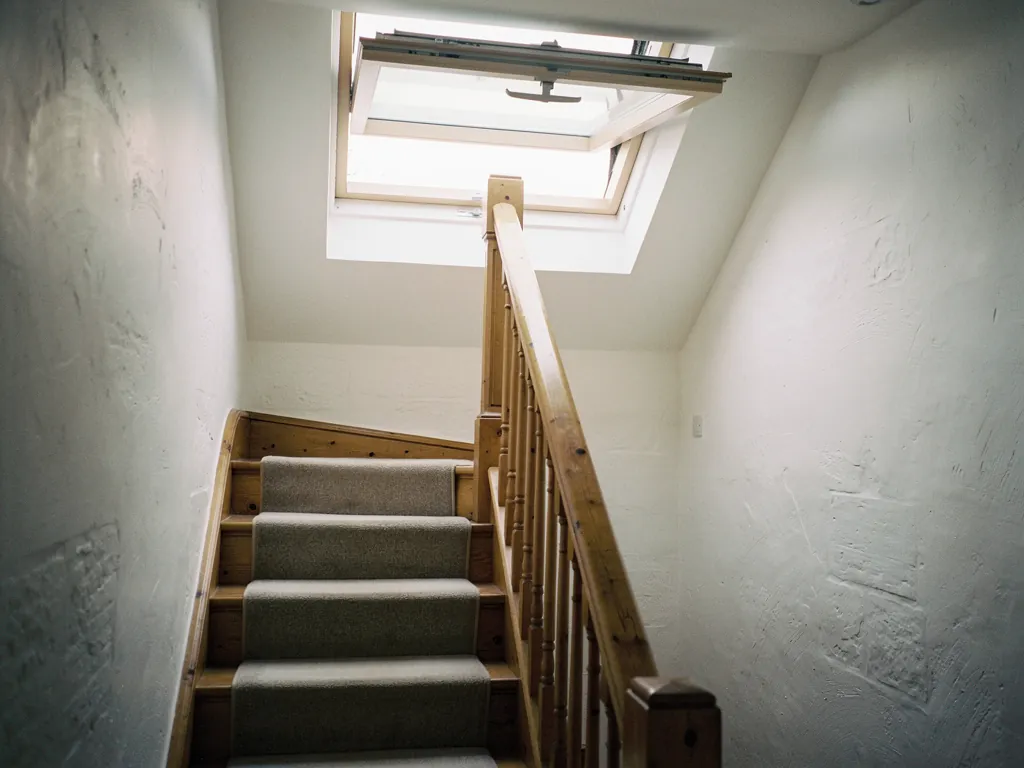
This is the reason we look at the whole house during a survey, not only the room getting the new unit. A roof window over the stair might do more for a stuffy loft bedroom than a second one in the bedroom itself, because it pulls the warm air past the bedroom door and out.
Purge ventilation and Part F
Building Regulations Part F deals with ventilation. It describes purge ventilation as the ability to clear a room quickly, for instance after painting, burnt toast or a crowded evening. An opening roof window can count towards purge ventilation for the room it serves.
The detail of how much opening a room needs sits in Approved Document F, and it depends on the room and the type of window. We check it for your rooms rather than quote a rule of thumb here. It is set out on the government's Approved Document F page if you want to read it yourself, and our guide to rooflight Building Regulations puts it alongside the other parts that apply.
On condensation, we keep the claim modest because the real effect is modest. A room that can be aired easily is a room where condensation has a fairer chance of clearing. It does not stop condensation forming, and it is not a treatment for damp. Our answer on stopping condensation on a rooflight explains what helps.
Three ways to open a rooflight
- Manual a handle on the sash, or a rod with a hook for one just out of reach
- Electric a small motor on a mains supply, worked from a wall switch, keypad or remote
- Solar the same motor, run from a battery that a slim panel on the frame keeps charged
- Vent bar a slot in the top of the frame that lets air through with the sash shut
- Rain sensor a pad on the frame that tells a motorised unit to close at the first drops
Manual suits a unit you can reach: a loft bedroom window beside the bed, or a kitchen rooflight you can get to from a step. It has no wiring and no battery, and it opens as far as the hinge allows. Top-hung and centre-pivot roof windows open differently, and the choice changes what you see and how much of the opening is clear. Our answer on top-hung versus centre-pivot roof windows sets out the difference.
Electric is the answer for a unit too high to reach, over a stair void or at the top of a vaulted ceiling. It suits a room being rewired or a new extension where a cable can be run easily. Solar is the same idea without the cable, which is useful in a finished room where chasing walls would mean redecorating. VELUX INTEGRA covers both, and other leading makers offer their own. The electric versus solar comparison goes into running and battery life.
Rain sensors and leaving it open
The reason people stop opening a high rooflight is the worry about rain. A rain sensor removes it. On a motorised unit, a sensor on the frame detects the first drops and closes the sash, whether you are in the garden, at work or asleep. Many units can also be set to close after a timed period, which helps on a hot day when you want the loft aired for an hour.
An open roof window will let the rain straight in.
A manual sash left wide in a downpour will, which is why a vent bar is the overnight setting. A motorised unit with a rain sensor closes itself as soon as the rain starts.
For overnight air in a bedroom, the vent bar is usually the better choice than an open sash. It lets a steady trickle of air through while the window stays closed and locked. Our answers on how a rooflight rain sensor works and leaving a rooflight open overnight cover the details.
Rooms where opening earns its keep
| Room | Why open | Usual choice |
|---|---|---|
| Loft bedroom | Warm air gathers under the roof | Manual roof window with vent bar |
| Top landing | Draws air up the whole stair | Electric or solar, rain sensor |
| Internal bathroom | Steam has nowhere else to go | Opening rooflight beside the fan |
| Kitchen extension | Cooking heat and sun on glass | Opening flat rooflight or lantern vent |
Kitchen extensions deserve a particular mention. A large fixed lantern on a south or west-facing extension can make the room uncomfortably warm in summer, because the heat collects under the glass with no way out. An opening section, or an opening flat rooflight elsewhere on the roof, lets it go without throwing the garden doors open. Our answers on opening roof lanterns and lanterns that overheat look at the options.
Where a fixed rooflight is the better call
Opening is not always right, and every quote we write says where we would keep a unit fixed. A fixed rooflight has fewer moving parts, a slimmer frame for the same glass, and often a lower price. The places it tends to win:
- Walk-on glass. A rooflight you stand on is fixed by design.
- Large spans over a dining table. One big fixed pane for the light, with a smaller opening unit nearby for the air, often works better than one heavy opening panel.
- A second unit in the same room. If one opening unit already airs the room, the next can be fixed.
- Some conservation roofs. Many conservation units do open, but in some listed settings a fixed pane is what the council will accept. See whether conservation rooflights open.
- Side-facing positions. Permitted development asks for obscure glass in a rooflight facing the side, and keeps it shut unless whatever opens sits higher than 1.7m off the floor inside. Our planning answer has the full conditions.
The comparison of fixed and opening flat rooflights goes further, and the hub for electric and opening rooflights covers every motorised option we fit.
Escape, safety and what opening does not mean
An opening roof window is not automatically a fire escape. Approved Document B allows an escape window only for a storey within 4.5m of the ground. A loft conversion on a two-storey house needs a protected stair instead. In a bungalow or chalet bungalow, a suitably sized roof window may serve as the escape window for rooms in the roof. Our answer on roof windows as fire escapes explains the sizes.
A sun tunnel, for completeness, brings daylight but does not open. For an internal bathroom short of air too, one route is pairing the tunnel with a ventilation kit; the other, where the roof allows, is an opening rooflight.
When you ask for a quote, tell us which rooms feel stuffy. We will mark on the quote where an opening unit helps, how it should open, and where we would leave the glass fixed. The costs page shows what each option tends to add.
Opening rooflights, the practical side
Can I add a rain sensor to a rooflight I already have?
Only to a motorised unit. A manual rooflight first needs converting to electric or solar, which some makers support with a retrofit kit. We can check your unit at the survey.
What happens to an electric rooflight in a power cut?
It stays where it was. Many units have a manual override, and solar units keep working from their battery. Our answer on electric rooflights in a power cut has more.
Will an opening rooflight make the room draughty in winter?
Not when it is closed. A modern unit seals as well as a good window. The vent bar lets in a small, controllable amount of air, and you can shut it.

Tell us about the room
A few details is all we need. We'll come out, advise and give you a written quote.
No pressure, no obligation.