Guide · Flat Roof Rooflights · 9 min read
Fixed or Opening Flat Rooflights: How to Decide
Every flat rooflight starts as a choice between glass that stays shut and glass that lifts. The fixed unit gives daylight and nothing else. The opening one also lets the room breathe, but only if it is reachable, powered where needed and placed where air will use it. This guide goes through the choice room by room.
What a lifting sash adds to a flat roof
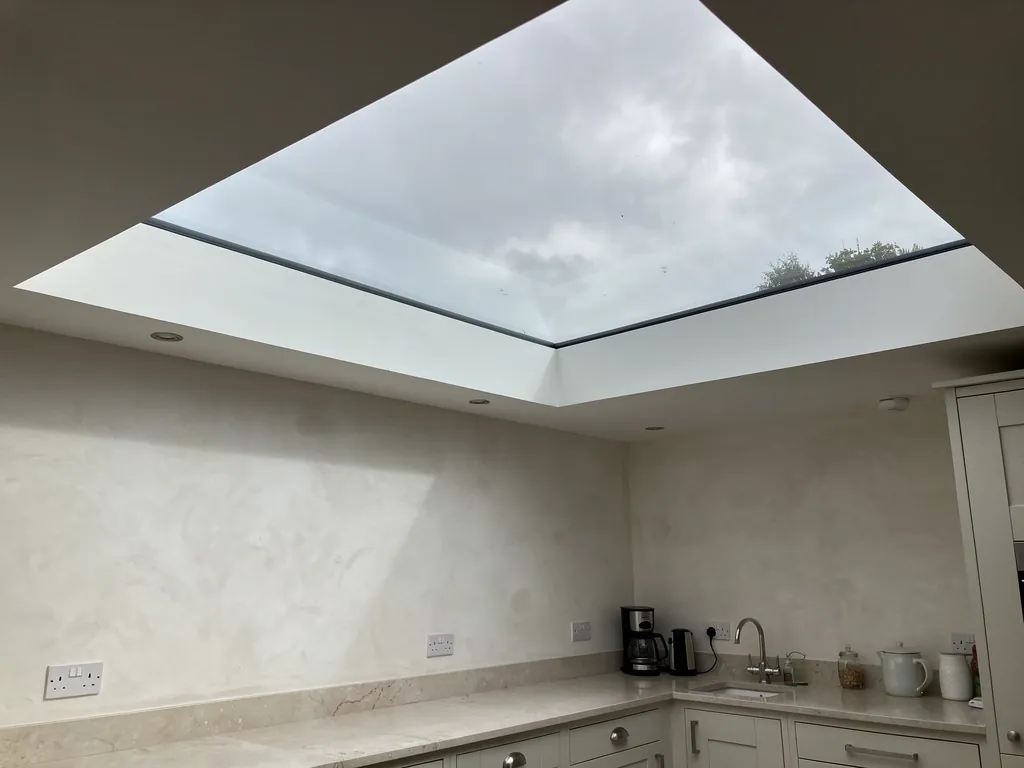
A fixed rooflight is simply glass sealed into a frame. It lets daylight drop into the room below and keeps the weather out, and that is all it is asked to do. An opening one has a sash that lifts clear of the frame on hinges or arms, so the glass itself becomes a vent at the highest point of the room.
Height matters because warm air collects at the ceiling. In a kitchen extension at the back of a Victorian terrace, the heat from the hob and the oven climbs and sits under the flat roof. A sash that lifts a little lets that layer drift out while cooler air comes in through a door or a side window. The same movement helps a bathroom clear its steam and a dim stair landing feel less shut in.
It is worth being plain about the limit. An opening rooflight does not condition the air or promise a dry room. It gives you a way to air the space on purpose, which a fixed unit never can. Whether that is worth the extra cost depends on what the room is short of, which is why the rest of this guide takes rooms one at a time. If you are still weighing up the whole flat roof job, the flat roof rooflight installation page sets out how we approach it from survey to finish.
Rooms where opening earns its cost
Four rooms make the strongest case for a sash that moves. In each, the roof is the best place to let air out because the walls are either shared with a neighbour or fitted with units.
| Room | What gathers | Helped by opening |
|---|---|---|
| Kitchen extension | Cooking heat and smells | One sash over the worktop side |
| Bathroom under a flat roof | Steam after a shower | A small unit with a vent setting |
| Home office | Warm, stale air by afternoon | A sash that opens without leaving the desk |
| Utility or boot room | Damp coats and laundry | A vent bar left on overnight |
A bathroom is a good example. Many terraces in Bishopston and Southville have a small rear bathroom with a flat roof above it and no outside wall to spare for a window. A modest opening rooflight puts the vent where the steam goes, and it can stay slightly open after you leave the room.
A kitchen is the other obvious case. In a long extension with a roof lantern or a run of fixed panes over the dining end, one opening unit near the cooking area usually does more for the air than doubling the number of fixed ones. We show opening options on every quote so you can see what that one change costs against the fixed alternative.
Rooms where fixed is the better unit
Anything that can open should open.
A sash you cannot reach, cannot power or never need is money spent on a hinge. Fixed glass is simpler, has fewer parts to wear and is the right call in plenty of rooms.
Fixed units suit rooms where air already moves freely. A through-lounge with bifold doors at one end does not need a roof vent. A dining area in a large extension is fine with fixed glass overhead if there is a side window or a door that opens onto the garden. A corridor that only needs daylight is a good home for a modest fixed unit.
Fixed is also sensible for very large panes. A wide rooflight over a big open-plan room is heavy, and the bigger the opening sash, the more demanding the hinges, arms and motor become. Two or three fixed units with one smaller opener beside them often make better sense than one large unit that lifts.
Walk-on glass is another case. A walk-on rooflight set into a roof terrace or a flat roof over a garage is built to take foot traffic and is nearly always fixed. If you need air as well, the opening unit sits alongside it rather than in its place.
How a flat rooflight opens
There are a few ways a flat roof sash moves, and the right one depends on how far you want it open and who will operate it.
- Hinged sash one edge stays fixed while the opposite edge lifts, like a lid
- Vent bar a small opening of the sash, enough for overnight air, held by a locking arm
- Electric actuator a motor that opens and closes the sash from a switch or remote
- Rain sensor a small detector that shuts an electric unit when drops land on the glass
- Locking arm a stay that holds a manual sash at a chosen angle
A manual hinged sash with a locking arm is the simplest option. You push it up and the arm holds it in place. It suits a rooflight within reach, such as one over a stair landing with a pole or one in a low-ceilinged utility room. No wiring is involved, and the running parts are few.
A vent bar adds a small gap that can be left set at night. It lets a trickle of air through while the sash stays shut against the weather. Many homeowners like it for a bathroom or a bedroom where a wide opening would be too much.
An electric actuator takes over when the unit is out of reach. It opens the sash at the push of a button, and the rain sensor shuts it the moment weather arrives. Our electric opening rooflights page covers the controls, wiring and sensor options in more detail.
Reach, power and who will use it
Reach is the first practical test. Stand under the spot where the rooflight will go and hold an arm up. If you can touch the frame or a handle within a normal stretch, a manual unit works. If you would need a stool, plan for electric.
Power is the second test. A motor needs a supply, and the simplest time to provide it is during the build, while the ceiling is open. In an existing room, we look at where a cable could run with the least disturbance and tell you at the survey if it looks awkward. Solar-powered options exist for some units and avoid a cable altogether, though the choice depends on the make.
The third test is the person. A flat rooflight over a child's bedroom, a bathroom or an older relative's room should be easy to use without leaning or climbing. A switch by the door and a rain sensor make the unit friendly to people who do not think about the weather. Someone who is happy with a pole and a latch will find a manual unit perfectly good, and cheaper to put in.
For both manual and electric, the sash is only as good as its fit to the frame. Fitting to the kerb matters as much as the unit; our guide to the rooflight kerb explains what the glass sits on and why it affects how well the sash closes.
Weather, security and glass on an opening unit
A sash that opens has more edges to seal than a fixed pane. That is a design matter rather than a worry, and a well-made unit closes tight against a gasket. The sash is fitted so that rain runs off the glass and down the roof rather than into the gap.
A rain sensor takes the guess out of it. If you leave an electric unit open and go out, the sensor detects drops and closes the sash. It is a good feature for a room you want to air all day, such as a kitchen or a home office.
For security, choose a unit with a locking arm or a lock that holds the sash shut when you are out. A locked sash on a roof out of sight of the street is a sensible part of the specification. No law asks for laminated inner glass under Part K; we suggest it, and it is worth considering over a bed or a busy worktop. The glass itself is a decision in its own right, and our guide to flat rooflight glass goes through the options.
Condensation is a related question. Opening the sash helps a room clear the damp air it has built up, though it is the glass and the insulation around the kerb that decide how cold the inner surface gets. See flat rooflight condensation for what causes it and what we do to reduce it.
The rules for a flat roof that opens
If you are comparing flat roof work as a whole, our flat roof rooflight service page lists every spoke guide. Part F covers ventilation and treats an opening roof window as a contribution to purge ventilation, the occasional quick airing of a room. The details of how much opening is required are for the building control officer, and we do not quote area rules on a page like this. It does mean that, in a new bathroom or a converted room, an opening rooflight can help satisfy the ventilation requirement where a fixed one would not.
Heat loss is a separate matter. Two figures from Part L 2021 apply to existing houses: a rooflight must achieve 2.2 W/m²K, while a roof window faces a stricter test (1.4 W/m²K, or Band B for energy rating). A flat roof opening unit is normally treated as a rooflight, but ask us how the specific product is classed on your quote.
When a whole flat rooflight comes out and a new frame goes in, that is notifiable building work, so we send the notice to Building Control for you. Changing just the sealed glass in a sound frame generally falls outside it. A new opening cut into a flat roof is building work too, because the structure has to be trimmed properly.
Planning is a different question. On a house in England, Class C permitted development usually covers a rooflight that projects no more than 150mm, sits no higher than the roof ridge and, if it faces the side, is obscure and fixed. Flats, maisonettes and listed buildings sit outside those rights, and a few conservation areas remove them, so see planning permission for a rooflight or ask your council.
Putting the choice on paper
A short list makes the survey faster and the quote more useful.
- Name the room and say what it is short of: air, light, or both.
- Say how high the ceiling is, and whether you could reach a handle.
- Say whether a cable could be brought to the roof or whether solar would suit better.
- Think about who will open it, and how often.
- Note whether another window or door already moves air in the room.
On the survey visit we study the ceiling height, the build-up of the roof and the way in, then measure for a unit that fits the kerb or the new opening. Our itemised written quote prices the opening and fixed versions side by side, so you decide with the figures in front of you. There is no obligation.
Want a rough sense of money first? Our costs page explains what moves the price, with broad market ranges. The fresh air rooflights page covers why we lead with opening units, and the guarantee explains the 10-year workmanship cover on every job. If you are fixing the size first, start with what size flat rooflight, and once you have a short list, the kerb is the next thing to settle.
Opening or fixed: the second thoughts before you order
Can one flat rooflight have both a fixed pane and an opening sash?
Yes, some designs pair a fixed pane with a smaller opening sash in one frame. It keeps the glazed area large while giving you a single vent. We show these on the quote where the roof opening allows it.
Will an opening rooflight let rain into a room?
A sash that is closed sits tight on its gasket and sheds water. Left open, a rooflight can let drops in, which is why an electric unit with a rain sensor is useful. A manual unit is best closed when you go out.
Is it worth fitting an opening unit if the room already has a window?
It can be, because a roof vent works with a side window to move air through the room. If the room already airs well, a fixed rooflight and the saving may suit you better. We will say so at the survey.
Tell us about the room
A few details is all we need. We'll come out, advise and give you a written quote.
No pressure, no obligation.