Guide · Roof Lanterns · 8 min read
Opening Roof Lanterns: Vents, Motors and Fresh Air
Most roof lanterns are sold as glass, yet the part that decides how the room feels in July is the vent. This guide covers how lanterns open, who each mechanism suits, how rain is kept out, and where a fixed lantern is the sensible choice.
What an opening lantern actually opens
A roof lantern is a glazed structure with a ridge and sloping sides. When people say opening roof lantern they rarely mean the whole thing lifts. One or more of the glazed panels is hinged, or a vent is built into a section of the frame, and that is the part that moves.
That detail matters because it shapes what you can expect. The vent releases warm air that has risen to the highest point of the room. It does not turn a lantern into a window you can lean out of, and it does not flood a room with a breeze the way a pair of open doors would. What it does well is carry stale, heated air up and out, while cooler air comes in elsewhere, through a door or a low window.
- Vent a hinged panel in the lantern that opens to let air out
- Actuator the small motor or chain that pushes the vent open
- Rain sensor a detector that closes the vent when drops land on it
- Vent bar a slim gap that holds a panel slightly ajar for air overnight
Because the lantern is the highest glazed point on a flat-roofed extension, a vent there works with the way warm air behaves. That is the whole case for an opening lantern, and it is why we show the opening option on every quote for these rooms.
Manual, electric or solar
Before choosing, picture a normal day. Who opens the vent, how often, and from where? A vent that is awkward to work gets left shut. A vent that opens from a switch by the kitchen door gets used every morning. The honest test of a mechanism is whether the household will use it without thinking.
Three ways of driving the vent are in common use, and the choice mostly turns on reach and wiring.
| Drive | How you work it | Needs | Suits |
|---|---|---|---|
| Manual | Pole or hand crank | Reach to the vent | Low lanterns, small rooms |
| Electric | Switch, keypad or remote | A power supply | High lanterns, new builds |
| Solar | Remote | A panel and battery | Existing rooms without spare wiring |
A manual vent is the plainest option. There is nothing to wire and nothing to fail except the hinges. The snag is height: a lantern over a double-height kitchen is out of reach from the floor, and a pole on the wall tends to go unused. Electric is the usual answer for tall spaces. A mains supply feeds a quiet actuator, and the vent is operated from a wall switch near the door.
Solar uses a small panel, built into the lantern or fitted beside it, to charge a battery that drives the actuator. It helps where the kitchen is already finished and the ceiling would need opening up for cable. Our guide to electric vs solar rooflight sets out the trade-offs, and electric opening rooflights shows the wider range.
Keeping the rain out
A motorised vent without a sensor is a vent you have to remember. With one, it can stay open while you are out or asleep. The sensor sits on the outside of the lantern and reacts to moisture, signalling the actuator to close the panel. Anyone who has lived with one soon stops thinking about the weather at all.
Noise is a small point worth knowing. A motor makes a gentle hum as it moves, and a vent closing in the night will be heard in a quiet bedroom, though not in a kitchen. Ask to hear one working if the lantern is over a room where people sleep or work.
Wind needs a thought as well. Some actuators close the vent if a sensor picks up strong gusts, and some systems can be linked to a wall panel that opens or closes every vent in the house at once. Those are extras, and we price them as options, not as part of the basic opening lantern.
Design helps too. On a pitched lantern the vent opens outward on its upper edge, so rain that lands on the glass runs down and over the closed section instead of dripping in at the opening. The gap that opens is a narrow slot, kept small by the actuator's limited travel, so wind-blown rain has less room to get in.
The same thinking applies to a vent bar. A vent bar holds a panel just ajar, enough to let stale air drift out at night. It is typically used on a closed panel with a restricted opening, which keeps the room secure while air moves. Our page on whether you can leave a rooflight open overnight goes into that in more detail, and the rooflight rain sensor page explains how the sensors behave.
Where the vent goes on the lantern
Position decides how well the vent clears the room. A lantern has a ridge at the top and sloping sides, and a vent can sit on either.
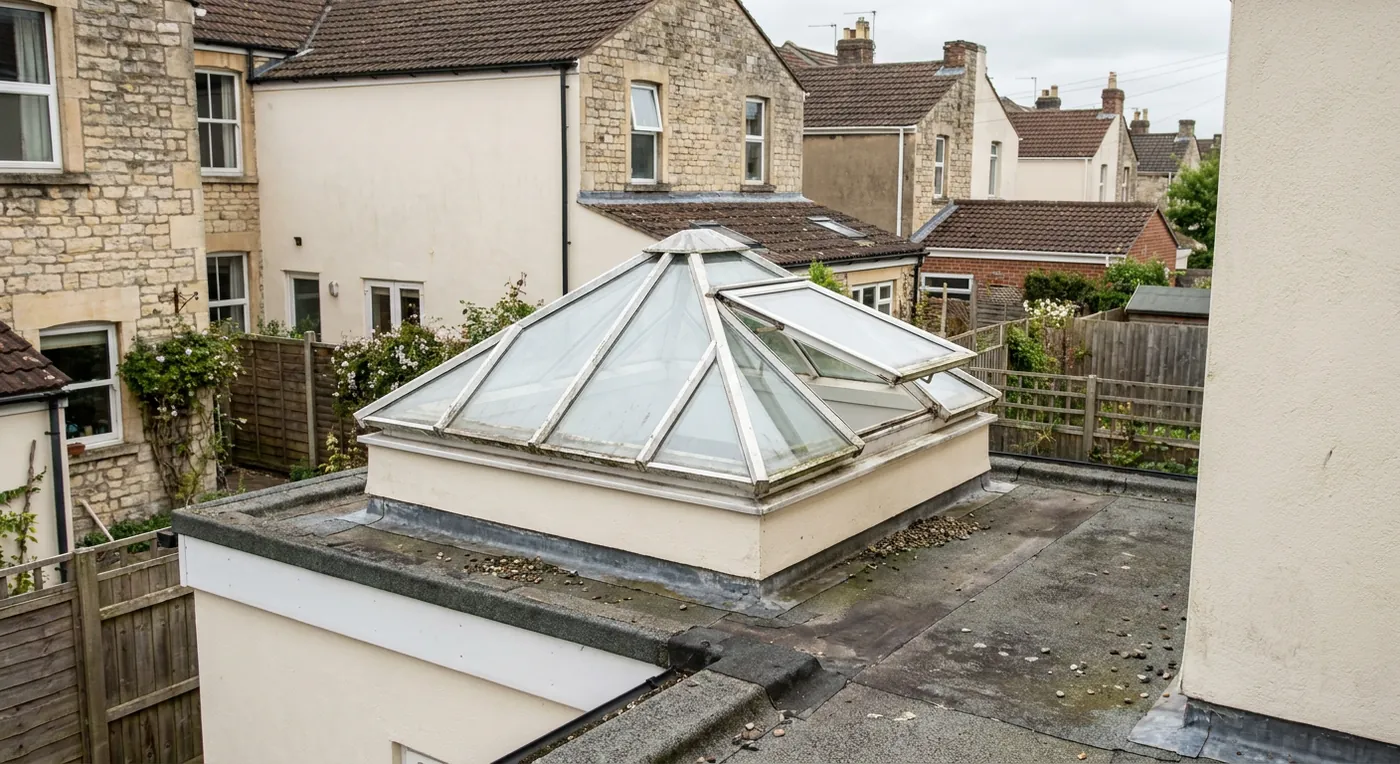
Vents on the sloping sides are the most common. They open outward on a hinge and sit close to the ridge, so warm air has only a short climb. A ridge vent runs along the very top and gives the most direct exit, though not every lantern design offers one.
The lantern pages in this section sit under our roof lantern installation hub, which is the place to start if you are still weighing up whether a lantern is right at all.
Think about where the hot air gathers. In a kitchen with a cooker or an island hob, the heat builds above that spot. A vent closer to it will clear steam and cooking warmth sooner than one on the far side. In a dining extension with bifold doors on one wall, the vent that helps most is usually the one on the opposite side from the doors, so that air crosses the room before it leaves.
Think too about what stands in the way. A vent that opens outward needs clear space above it, so a nearby parapet, a neighbour's wall or a rooftop plant box can limit how far it travels. That is checked at the survey, along with how the vent will clean, since a panel that opens is also one you can reach to wipe down.
Orientation counts as well. A vent on the north-facing slope opens away from the sun and is gentler on the fabric in summer. A south slope may collect more heat but gives the strongest draw. We talk this through on the survey, where we can see which way the roof faces and where the heat actually gathers.
Does one vent do the job?
Every pane of an opening lantern should be able to open.
One well-placed vent usually does more good than several poorly placed ones. Extra vents add cost, more moving parts and more to maintain.
A single vent works best where there is somewhere for fresh air to come in. If the room has a door or window on the other side, even a modest vent sets up a flow. If the extension is closed off with nowhere else to open, a second vent on the opposite slope can help, since air can enter at one and leave at the other.
Very large lanterns, or lanterns over open-plan rooms in a terrace in Southville or an opened-up semi in Henleaze, sometimes benefit from two vents. That is a judgement made at the survey based on the room and the lantern, not a rule.
Keep in mind the glass area too. Large lanterns warm up in summer sun, and the cure is a mix of glass choice, blinds and venting. The page on roof lantern overheating covers how the pieces fit together.
When a fixed lantern is the better call
Not every lantern needs to open. A fixed one is simpler, has no moving parts, and costs less, which can be money better spent on glass or a bigger footprint.
Fixed makes sense when the room already has good ventilation, such as an extension with large opening doors and a utility area with its own extraction. It suits a dining room used mainly in the evening in cooler months, and a lantern too high or too awkward to reach without a motor you do not want to pay for. It also suits a small lantern where there is no room for a decent vent.
Cost and complexity are real factors. Every moving part is one more thing to commission, test and keep running. A fixed lantern can be installed, signed off and then forgotten, which is a perfectly good outcome for a busy household. If the room has enough natural air from doors, extraction and a flat rooflight elsewhere, the fixed lantern gives you the glass and the structure without the extras.
The other point is the room's use. In a bedroom or home office on the ground floor of an extension, a quiet room with no opening roof can be a comfort. A vent that sits above a bed brings noise from rain and the garden.
We set out both versions, opening and fixed, on the written quote so you see the price difference line by line. For figures, see roof lantern cost, and the costs overview for typical UK market ranges. Deciding at the outset is cheaper, because adding a vent to an existing fixed lantern usually means replacing the panel or the whole lantern.
Rules and sizes that touch the vent
Part F covers ventilation, and an opening roof window can count as purge ventilation. A lantern vent is a different product, so ask us on the survey how it would be treated for your room. We handle the Building Control notification where the work is notifiable.
Fitting a new lantern, or replacing an old one entirely, is building work. The frame, kerb and structure need to meet the regulations, and a motorised vent needs a safe electrical supply installed by a competent electrician. Our roof lantern building regulations page covers the rest.
Size and vent number are linked. A larger footprint can take bigger or more vents, and a very small lantern may have no space for one. Read the roof lantern sizes guide before you settle either, and the roof lantern installation page for how a job runs.
Frame material also affects how the vent looks and moves. We compare the two in aluminium vs timber roof lantern. If you would like the vent decided properly, our free survey and written, itemised quote shows the opening and fixed choices side by side, with no obligation. Ten years of workmanship cover is set out in the guarantee.
Vents on a lantern: what owners ask once the glass is chosen
Will an opening lantern make my kitchen draughty?
No. A vent opens a narrow gap at the top of the room and lets warm air out. It is not a door, and it can be closed whenever you like. With a rain sensor and a wall switch it is simple to use day to day.
Can a vent be added to a lantern I already have?
Sometimes a panel can be swapped for an opening one, but it depends on the lantern's make and frame. In many cases the cleaner route is a new opening lantern. We check which at the survey and show the options in writing.
Who looks after the motor and sensor?
The actuator and sensor need little more than a clean and a check that the vent travels freely. If a part fails it is replaced. The ten-year workmanship guarantee covers our installation work, and the maker's own terms cover the parts.

Tell us about the room
A few details is all we need. We'll come out, advise and give you a written quote.
No pressure, no obligation.