Guide · Electric & Opening Rooflights · 9 min read
Electric or Solar Opening Rooflights: How They Compare
A powered rooflight opens from a switch or a remote, and there are two ways to feed it. Electric units take their power from a cable, solar units from a panel built into the frame that tops up a battery. Both can close themselves when it rains. This guide sets the two side by side, so you can see which one suits your roof, your walls and your habits.
Two ways to power the same idea
Reaching a rooflight is the whole problem. A window set into a loft slope above a stairwell, or in a kitchen ceiling three metres up, is no use if the only way to open it is a pole and a ladder. A motor in the frame solves that, and the choice that follows is where the motor gets its power.
Electric means a cable. A supply runs to the window, a control unit sits somewhere sensible, and the motor draws what it needs when it moves. Solar means a small photovoltaic panel set into the window frame. It trickles charge into a rechargeable battery, and that battery drives the motor. There is no cable to the house at all.
VELUX INTEGRA is the range Bristol homeowners meet most, and it comes in both forms: an electric version and a solar version of the same window. Other leading makers offer comparable powered options, so the points below apply across the market and not to one catalogue.
Before picking, it helps to know that the parent page on electric and opening rooflight installation covers the whole family of powered units, including how they are controlled and what a survey looks at. This page is only about the fork between cable and panel.
What electric asks of your house
An electric rooflight needs a supply, and that is the first thing a survey checks. If the room is being rebuilt, plastered or rewired anyway, the cable is a small extra: it goes in with the other circuits before the ceiling is closed up. If the room is finished and decorated, the cable has to find a route from the nearest suitable spur to the window, and that route can mean lifting boards in the room above, chasing a plaster wall or running trunking along a joist in a loft void.
The wiring side is covered step by step in our guide to electric rooflight wiring, including who does the work and what is certified. The short version is that a qualified electrician makes the connection and signs it off, while the roofing side is ours.
What you get in return
A cabled window has no battery to wear out and no dependence on daylight. It works at night, in a north-facing slope and under a tall tree, and it works in the dark weeks of December just as it does in July. Several windows can share one control point, so a single wall switch or one handset can open every rooflight along a landing at once.
Cabled units also suit the places where a cable is already close. A bathroom has a supply for the extractor and the lights. A kitchen extension has sockets and an oven circuit. A loft conversion that has just been rewired has a ring and a lighting circuit within a few metres of every roof window. In each case the extra run to the window is short.
The trade-off is plain: once the walls are finished and the carpets are down, adding a cable becomes the expensive part of the job rather than the window.
What solar asks of your roof
A solar rooflight asks for daylight, not for a cable. The panel is small and is part of the frame, so it does not look like a roof-mounted solar array. It needs enough light across the day to keep the battery topped up, and it needs that light on the glass itself.
That makes the aspect of the slope matter. A south or west-facing roof in Bath or Clifton will charge the battery easily. A north-facing rear slope, a roof shaded by a neighbour's chimney stack, or a window sitting in the shadow of a taller extension will charge more slowly. Even then, a window that is opened and closed once or twice a day uses very little energy, and the battery holds a good reserve. But a unit that is rarely in light is the one to be cautious about, and we say so at the survey.
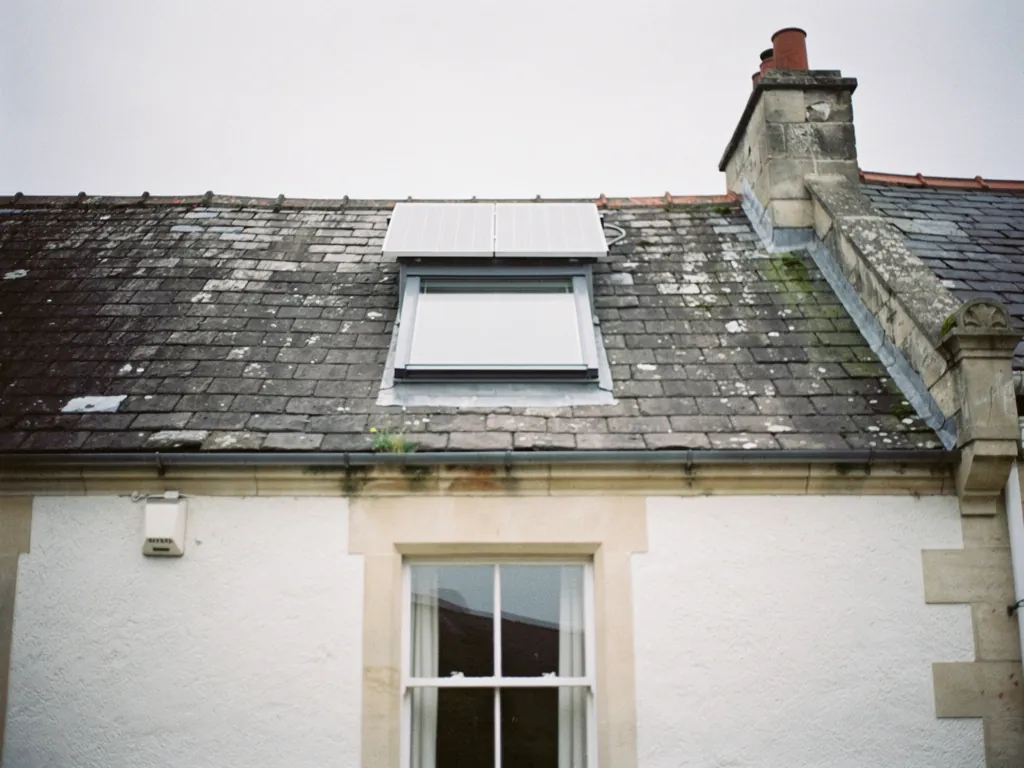
The real gain of solar is the work it does not need. A Victorian terrace with lime plaster, a Georgian ceiling with a decorative cornice, a loft room that has just been decorated: these are the places where chasing a cable would mean redecoration. The solar version goes in with the same roof opening and the same flashing as any other window, and the room below stays as you left it.
It also helps on a roof where the nearest supply is a long way off. A detached garage conversion or a garden room at the bottom of the plot can have an opening rooflight without a trench or a long run of cable from the house.
The two side by side
| Question | Electric | Solar |
|---|---|---|
| Power | Cable to the window | Panel and battery in the frame |
| Wiring needed | Yes, by an electrician | No cable to the room |
| Best moment | New build, rewire, extension | Finished and decorated room |
| Light on the roof | Does not matter | Helps to have some |
| Wear item | Motor only | Motor and battery |
| Rain sensor | Available | Available |
Reading across, neither column wins every row. Electric is the more dependable choice where the supply is easy and the roof is shaded. Solar is the less disruptive choice where the room is finished and the roof sees the sun. A mixture is common in houses with more than one window: a cabled pair in the new extension and a solar one over the existing landing.
It is also worth being clear about what the table does not say. It says nothing about a better product. Both kinds are made to the same standard as the manual window they stand in for, with the same glass options and the same flashing. The motor and the power are the only changes, which is why a window can often be specified either way from the same range.
Rain sensors and what happens when the weather turns
The reason many people choose a powered window at all is the rain sensor. A small sensor on the glass notices moisture and tells the motor to close the sash. The window can then be left open while you go out, or while you sleep, without a wet floor waiting for you.
Both power types can carry one, so the sensor is not a reason to choose electric over solar or the other way round. Our page on the rooflight rain sensor goes through how it behaves, what it can and cannot see, and how to test it.
A solar window cannot close in the rain at night, because the sun has gone.
The battery does the work, not the sun at that moment. The sensor and motor run from the stored charge, so the window closes whatever time it rains.
A powered window also behaves differently from a manual one when the power is interrupted. A cabled unit depends on the supply, though most can still be moved by hand with a manual override. A solar unit has its own reserve and is not tied to the house supply. What a cut in supply does to the window is covered in electric rooflight power cut.
Anyone who likes a window open while out or asleep will find the full picture, with the vent bar position set against fully open and closed, in the answer on leaving a rooflight open overnight.
Controls, remotes and smart homes
Either power type can usually be operated by a wall switch, a handheld remote or a keypad. A single remote can work several windows, and some systems link into a home control hub so that windows close with the heating schedule or let air in on a timer once the morning warms up.
Cabled windows tend to have more choice in how they are controlled, because a wall control can be wired alongside the supply. Solar windows are generally wireless throughout, which suits a handheld remote and a keypad fixed to a wall. If you want a switch in a specific place, say beside the bedroom door, we plan that into the survey notes, since it is easier to place a control before a ceiling is closed than after.
The decision on controls is easier than it sounds. Ask where you will stand when you want the window to move: beside the bed, at the bottom of the stairs, in the kitchen with wet hands. The answer picks the control, and the control narrows the power choice a little. A switch fixed to a wall sits happily with a cabled window, while a remote sits happily with both.
Cost and the work involved
On price, the usual pattern across the UK market is that a powered window costs more than the same window opened by hand, and that the difference between electric and solar is smaller than the difference between either and manual. Where electric costs more, it is usually because of the wiring, not the window. Where solar costs more, it is the panel and battery inside the unit. Exact figures depend on size, glass, the roof and the access, so the free survey ends with a priced, line-by-line quote that lists both powered options when both would work.
What the numbers are made of is unpicked on electric rooflight cost, while the site-wide costs page covers broad UK market figures for every kind of rooflight and roof window.
Changing an existing window
Many homeowners already have a manual roof window and wonder whether it can be changed. In some cases a conversion kit can add a motor to an existing unit, and in others the whole window is replaced. That decision turns on the make and age of the frame. For a manual window you already own, converting it to electric is the route to look at, and a solar kit follows the same logic.
Swapping the whole unit for a powered one counts as building work that is handled with the council's Building Control service, and the paperwork for that is ours to send. A new opening is also building work, and the roof structure must be trimmed properly. Neither depends on the power type.
How to decide, room by room
- Spur a branch from an existing circuit that feeds one extra item
- Trickle charge a slow top-up that keeps a battery full
- Override a manual way to move a powered window if the power fails
- Aspect the compass direction a roof slope faces
The easiest way to decide is to take each window in turn rather than the house as a whole. A pair of questions does most of the work: is there a supply close by, and does this slope get daylight?
- If the room is being built, rewired or replastered, choose electric, because the cable costs little at this stage.
- If the room is finished and the slope faces south, east or west, choose solar, because it keeps the decoration intact.
- If the room is finished and the slope is shaded, ask us to look at both, because cabling may be worth the disruption.
- When a window would sit out of reach and seldom be opened, a fixed unit with a separate vent elsewhere is sometimes the simpler answer.
Bristol homes show the pattern clearly. A Victorian terrace loft in Totterdown or Bishopston, with new plaster and a south-east slope, suits solar. A modern extension in Bradley Stoke, wired during the build, suits electric. A Georgian landing in Bath, in a conservation area, may call for a conservation rooflight in an opening version, where the choice of power is tied to which models are offered. Our page on fresh air rooflights shows where opening units earn their place, and the VELUX INTEGRA page covers that range in detail.
The survey is free and the quote carries no obligation. It shows both powered options next to a manual one, so the comparison is on paper in front of you rather than in our heads. Every related guide sits together on the electric and opening rooflight hub.
Powered rooflights: what people ask once the shortlist is down to two
Does a solar rooflight work through a dull Bristol winter?
The panel charges from daylight, not direct sun, so a grey day still adds some charge. The window uses little energy for each opening and closing, and the battery holds a reserve. A slope in deep shade is the case to raise at the survey, where we may suggest a cabled unit instead.
Can I put an electric and a solar window in the same room?
Yes. Each window is independent, and mixing is common where one slope is shaded and another is not. Several units can often be brought under one handset or one wall control, depending on the system, so you do not end up with two remotes.
Which is easier to replace in future, the electric or the solar kind?
Both are fitted into a standard roof opening with the usual flashing, so replacing either follows the same steps. The solar battery is the one part that is designed to be changed over the life of the window, and the motor in either kind can be swapped if it fails.
Tell us about the room
A few details is all we need. We'll come out, advise and give you a written quote.
No pressure, no obligation.