Guide · Electric & Opening Rooflights · 8 min read
Rain Sensors and Smart Controls for Rooflights
Some mornings you want the roof window open and some afternoons you want to be out of the house. A rain sensor lets you do both. It notices the first drops on the glass and tells a powered window to close. This guide explains what is inside the sensor, how it is set up, what it does well and the few things it leaves to you.
What the sensor is and where it sits
On a powered roof window, the rain sensor is a small flat panel on the outer glass or the frame, wired to the window's control unit. It has a grid of fine contacts on its surface. A dry surface lets nothing through. A few drops bridge the contacts, the sensor registers moisture and the control unit sends a close signal to the motor.
That is the whole idea, and it is plainly simple. There is no weather forecast, no link to the internet and no judgement about whether the shower will be heavy. If water lands on the panel, the window closes. Some sensors include a small heater, so that mist or dew does not set them off by mistake.
The sensor belongs to the family of powered windows described on the electric and opening rooflight installation hub. It works with both cabled and solar versions, which are compared in the comparison in electric vs solar rooflight. The VELUX INTEGRA range carries a rain sensor as part of the window, and other leading makers offer similar options.
How automatic closing works step by step
It helps to follow one shower from start to finish.
- You leave the roof window open on a warm morning and go out.
- Cloud arrives. The first drops fall on the sensor panel on the glass.
- The contacts register the water and the control unit decides the window should close.
- The motor drives the sash shut, and the window stops against its seal.
- When the rain ends and the glass dries, nothing happens. The window stays closed until you open it again.
The last step is deliberate. A window that re-opened by itself would be an unwelcome surprise on a day when you are away and the forecast is changeable. Most systems wait for you to use the remote or the wall control. If you want a window to open at a set time, that comes from a separate timer or a smart home link, covered further down.
The whole sequence takes the time it takes the sash to close, which is usually a short moment. The speed is not set by the rain sensor but by the motor, which moves at a measured pace to avoid a slam.
Automatic skylight closing is a feature of the window, not an add-on you buy later in most cases. The simplest way to have it is to choose a unit that includes it at the start. Adding it to an existing powered window depends on the make and the control unit, and we check that at the survey.
Setting it up and testing it
A sensor needs very little setting. It is connected when the window is fitted, and the installer tests it before leaving. You can test it yourself at any time, and doing so is a sensible habit at the start of autumn.
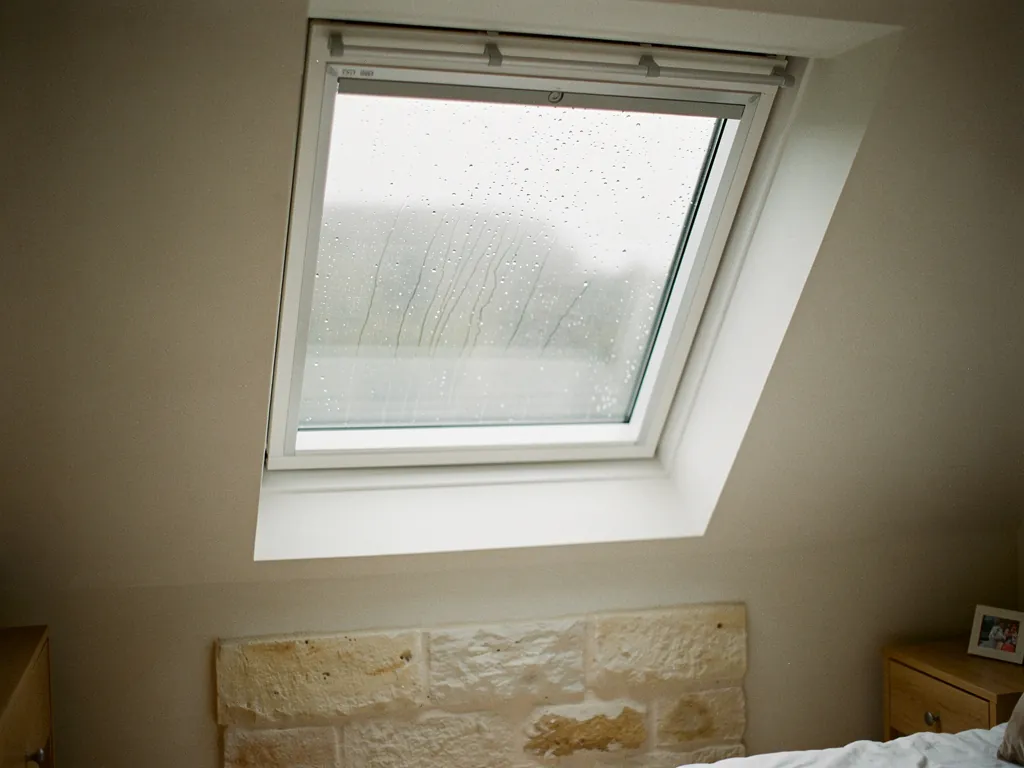
A simple home test
Open the window part-way. Wipe the sensor panel dry, then put a few drops of water on it from a cup or a clean sponge. Within a moment the window should start to close. Dry the panel again afterwards. If nothing happens, check that the control is switched on and the battery or supply is working before assuming a fault.
Most sensors do not need a ladder. Where the window is beyond arm's length, a long-handled sponge or a damp cloth on a pole will do, or a gentle spray from a garden spray bottle held at arm's length from an upper window.
Keep the sensor panel clean. Pollen, bird droppings and dust can build up and make the surface less responsive. A wipe with warm water and a soft cloth when you clean the glass keeps it working. Avoid abrasive pads and strong cleaning fluids, which can mark the contacts.
What a rain sensor can and cannot do
A rain sensor is dependable at the one thing it is designed for. It is less useful at other jobs people sometimes expect of it, so it is worth being clear.
| Situation | What happens |
|---|---|
| Rain on the glass | Window closes |
| Sudden heavy shower | Window closes, a few drops may land first |
| Wind-blown rain from the side | Closes, but only once the panel is wet |
| Rain on a closed window | Nothing to do |
| Cold or windy dry weather | No response |
The row worth reading twice is the second. The sensor reacts when water touches it, so the first few drops may land on the sill before the sash is shut. That is a short interval, not a flood, and it is why a sill with a little ledge, or a floor that is not precious directly under the window, is a good idea.
A rain sensor will close the window if a storm is forecast.
It only reacts to water on its own surface. It has no forecast. If a storm is due and you are away, close the window yourself first.
Nor does the sensor respond to wind, cold or a drop in light. A window left open on a cold, dry night stays open until you close it. If you want that kind of control, it comes from a thermostat, a timer or a home hub, not from the rain sensor.
Smart controls and schedules
Rain sensors are often confused with smart controls, but they do different jobs. The sensor reacts to the weather outside. A smart control follows your instructions, usually by schedule or by app.
Controls fall into three simple kinds. A wall switch or keypad gives a physical button in a place you choose. A handheld remote works one window or several, which suits a landing with a row of roof windows. A smart link connects the windows to a hub, so they can be told to close when the heating comes on or open on a timer through the summer.
Whichever you pick, the sensor stays in the loop. It is the last line of defence, and most systems treat a wet panel as an instruction that beats any other command. It is a good thing to ask about at the survey, since a few older control units behave differently.
There is also the question of the window's own position. A fully open sash lets the most air through, and a smaller gap, sometimes called a vent position, lets less. Automatic closing works from either, and which setting suits a bedroom at night is worked through in leave rooflight open overnight.
Power and the rain sensor
The sensor needs power as well as the motor. In a cabled window the control unit supplies both. In a solar window the battery supplies both, which is why the panel and battery are sized for the motor and the sensor together.
When the supply is interrupted, the usual question is whether the window can still close. A cabled window with no power cannot run the motor, so the rain sensor cannot do its job until the supply returns. Most such windows can be closed by hand using a manual override, which is worth knowing where it is. How a window behaves during an outage has its own answer, under electric rooflight power cut. A solar window runs from its battery and carries on, as long as the battery has charge.
Because of this, it is wise to treat the rain sensor as a convenience, not a guarantee. If you are leaving the house for a few days in a wet month, close powered windows yourself, and let the sensor handle the short, unexpected showers it is built for. The same sense applies to a nightly vent position, and it applies more strongly for a window above a bed or a laptop.
If you are comparing power types with automatic closing in mind, the answer is mostly the same for both. Our guide to the difference between electric and solar rooflights covers the trade-offs, and the electric rooflight wiring page explains what a cabled window needs from the house.
Where automatic closing earns its place
- Sensor panel the small wet-sensing surface on the glass
- Control unit the small box that decides when the motor moves
- Vent position a small opening gap, narrower than fully open
- Override a hand method of moving a powered sash
Not every window needs a sensor, and some rooms use it far more than others. The room tells you whether it is worth having.
Loft bedrooms. A roof window beside a bed is easy to reach and rarely needs a sensor in the day, but at night it is a different matter. You may want it open on a warm evening and have no wish to wake up to a shower. The sensor earns its place here.
Landings and stairwells. A window high above the stairs is out of reach, so the sensor is not a luxury. It does the closing that a pole and ladder would otherwise do, and a tall stair void in a Victorian terrace is an obvious candidate.
Bathrooms. A window above the bath can be left open after a shower to help steam leave the room. A sensor stops it filling the room with rain if the weather changes while you are downstairs.
Kitchen extensions. A flat rooflight with one opening unit near the hob can be left open while you cook. Because flat roofs shed water slowly, a sensor is a sensible companion, and our page on flat roof rooflights shows the opening options.
For a sense of what a sensor adds to the price, our page on electric rooflight cost breaks the sums down, and the costs page shows typical UK market ranges. For an existing manual window, converting it to electric can bring a sensor along with the motor.
Fitting, survey and what to ask
The survey is where the sensor question gets answered for your roof. We look at the slope, the position of the window, how the room is used and where the controls would sit. Opening options are shown on every quote, and a rain sensor appears as a separate item, which makes its contribution to the price easy to read.
Questions worth asking any supplier are practical ones. Is the sensor included or separate? Does it have a heater to stop dew setting it off? Does the window stay closed after rain until I tell it to open? Where is the manual override? Which controls does it work with? None of these needs a technical answer, only a clear one.
The work itself is carried out by one team, with the slope sealed against weather each evening and the floors protected. A whole new window goes through Building Control, and we send that notification ourselves where it is needed. Our work carries a 10-year workmanship guarantee, with the terms on the guarantee page.
The electric and opening rooflight hub shows how the sensor sits among the other powered options.
Rain sensors in practice: the odd cases people raise
Will a morning dew set the sensor off?
Dew can wet the surface, which is why many sensors carry a small heater that keeps the panel clear of condensation. If a window closes itself on a misty morning, it is worth mentioning at the survey or to the installer, as a setting or a different panel may help.
Does a rain sensor stop working if the panel is dirty?
A thick film of dust or bird droppings can make it slow to respond. Wiping the panel with warm water and a soft cloth when you clean the glass is enough. Avoid scouring pads, which can scratch the contacts.
Can I add a rain sensor to a window I already have?
Sometimes. It depends on the make of the window and its control unit. A manual window usually needs conversion first, and a powered window may take a sensor as a plug-in part. We check at the survey and list it separately on the quote.

Tell us about the room
A few details is all we need. We'll come out, advise and give you a written quote.
No pressure, no obligation.