Guide · Roof Windows · 8 min read
Top-Hung or Centre-Pivot Roof Windows: Which Opens Better?
One roof window rotates around a middle line, the other hangs from its head like an awning. Both are common in Bristol and Bath lofts, and the difference shows up in where you stand, what you see and how the air moves, so this guide compares them room by room.
Two hinges, two behaviours
Most pitched-roof windows open in one of two ways, and the hinge decides everything else about how the window feels to live with.
On a centre-pivot window the sash is held by pivots set roughly halfway up the frame. You lift a handle along the top edge and the sash rotates around that line, so the lower half swings into the room and the upper half swings out over the roof. It can turn right over, which brings the outer pane indoors to be cleaned.
On a top-hung window the hinges sit along the head of the frame. The handle is at the bottom, you push the sash up and outward, and it hangs open like an awning, with the whole opening clear beneath it. It also has a smaller ventilation setting, so a gap of air can pass through without the sash swinging wide.
Both are real roof windows with their own flashing, glazing and frame, and both can be manual, electric or solar. Neither is the premium choice. They are two answers to two slightly different questions, and our page on roof window installation covers the wider range they sit in, and the same hub links to every spoke on this subject.
How each one sits when open
Open a pivot window in a loft and the lower edge of the sash comes into the room. That matters in a bedroom with a bed head under the slope, because a sash swinging inward needs clear space beneath it. The pivot point is high enough up the slope that the inward edge stays above head height in a standard layout, but a desk or a tall wardrobe tucked right under the window needs a look at the survey.
A top-hung window leaves the room alone. All the movement is outside, over the roof. You can stand directly under it, lean on the sill and look out, and nothing swings at your face. The price is that the sash sits proud over the slates when open, so a strong gust has something to push on, and the open sash blocks a little of the view upward.
| Question | Centre-pivot | Top-hung |
|---|---|---|
| Handle position | Top of the sash | Bottom of the sash |
| Sash movement | Half in, half out | All outside |
| Outer glass | Turns over indoors | Needs a reach or a pole |
| View out | Sash across the middle | Clear opening under the sash |
The table sums it up, but the real test is standing in the room. At the free survey we can hold a tape measure where the sash would swing and show you what the open window would occupy.
Reach and handle height
Handle position is the practical difference people notice first. A pivot window has its handle at the top of the frame. Fitted high in a slope, that handle is out of reach, which is why a rod or an electric motor comes with a high pivot. Fitted low, with the sill around waist height, the handle sits at head or shoulder level and works without a stretch.
A top-hung window puts the handle at the bottom. Fit it high and the handle is higher too, though still lower than a pivot's. Fit it at sill height and it is easy to grab, even from a bed or a chair.
A higher roof window is always out of reach.
Reach depends on the hinge as well as the height. A top-hung sash brings its handle to the lower edge, and an electric motor or a rod removes the issue on either type.
Think about who uses the room. A teenager's loft bedroom, a guest room used a few nights a year and a home office used every day each need a window that gets opened without effort, because a window that is awkward to open stays shut. If the unit will be beyond reach, look at the electric opening rooflights instead of a rod.
Cleaning the outer glass
Roof glass collects pollen, bird marks and a film of city grime, and it is the one pane you cannot easily reach from a ladder on a Victorian terrace without getting onto the roof. This is where the pivot shows its strength. Turn the sash through half a circle, latch it in the cleaning position and the outer face is at arm's length inside the room.
A top-hung window cannot do this, because the sash only swings out. You wipe what you can reach from indoors with a long-handled cloth and a pole, and the rest needs access from outside. For a window in a bathroom or kitchen, where steam leaves a film, that is a point against it. For a window on a quiet bedroom slope, it hardly matters.
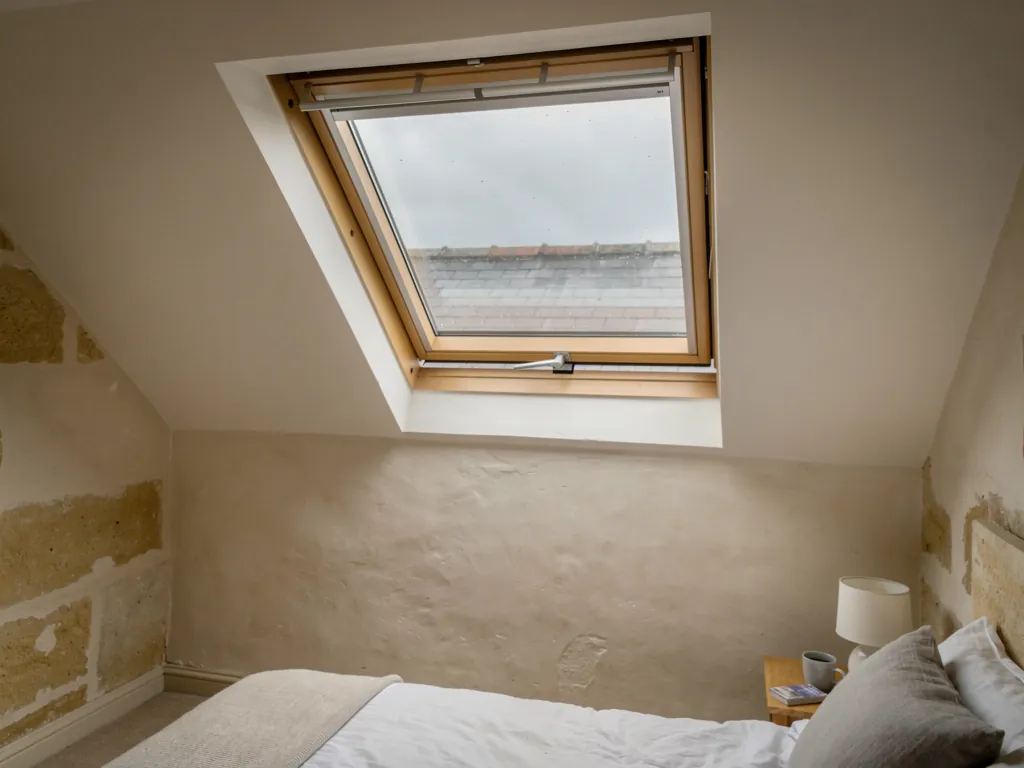
If cleaning is a worry, ask on the survey whether a self-cleaning outer coating is offered on the glass you are choosing. It helps with rain-wash, but it does not replace a wipe now and again.
View, headroom and the open sash
The view out of a roof window is a lovely thing in Clifton or Bath, where a slope can look over chimneys, rooftops and the hills beyond. It also differs between the two types.
A top-hung window opens to give a framed, uninterrupted view, with the sash overhead. It suits loft rooms where someone wants to sit at a desk below it, look out at the street or lean out to feel the air on their face. The sash is held open at a set angle by its stays, so it does not swing about when the wind rises.
A pivot window shows the sash as a diagonal in the middle of the view. Its upside is that a tall person standing under it finds the lower edge pushed away into the room above head height, so there is a clear walk beneath once the angle is set. Its downside is that the sash edge sits across the sightline when open.
That second point is useful on a hot night. A pivot window has two gaps, one at the top where the sash leans out and one at the bottom where it leans in, and that arrangement suits natural air movement up the slope.
Which room suits which
Think about the room before the hinge. These pairings are a guide, not a rule, and a survey may reverse them.
- Loft bedroom on a 1930s semi. Either works. A top-hung is simple for someone who wants a clear sill, and a pivot suits a window set high where cleaning from indoors counts.
- Bathroom in the roof. A top-hung opens clear of steam and gives the ventilation setting for a gentle draw. A pivot works well too if you plan to wipe the outer pane.
- Top landing. A pivot or an electric top-hung, set high so warm air from the stairwell leaves from the highest point.
- Loft study. A top-hung for the view and a clear opening beneath the sash.
- Bungalow or chalet room. Top-hung versions are the ones made as escape windows, so choose with the rules in mind. See our page on roof window fire escape.
In a Georgian roof in a conservation area, the choice may be narrower than this, because a slim conservation unit has its own opening patterns. The conservation rooflights page explains what can open there.
Motors, rain sensors and the two hinges
Either hinge can be driven by a motor. On an electric or solar window the motor does the lifting, so handle height stops mattering, and a rain sensor closes the sash when the weather turns. That makes a high window practical, and it suits a landing or a stair void where nobody could reach a handle.
The motor does shape the choice a little. A top-hung sash swings further from the frame and has a long throw, so the motor works against more leverage, while a pivot turns about its balance point and moves with less effort. Both are handled by the makers' own motor kits, and we fit the kit that belongs to the window rather than mixing parts. The VELUX INTEGRA range is the electric and solar line, with remote control and rain sensing built in.
Solar versions help when the loft is already finished, because there is no cable to bring up the wall. Wired versions suit a room under construction, where the electrician can run a spur before the plasterboard goes on. Either way, we show the manual and the powered price on the same quote so the extra cost is plain.
A useful question for the survey is how you will close the window. If the truthful reply is "someone will remember", a rain sensor earns its place. If the room is a study with someone in it all day, a manual handle is fine.
Fitting, flashing and the same rules
The two types go into the roof in much the same way. Both need an opening trimmed between rafters, a frame secured to the structure, a flashing kit matched to the roof covering and a weathertight finish before we leave each day. The sizes are the same standard range, and the VELUX size code tells you the width by letter and the height by digits. Our page on roof window flashing sets out the kit differences between slate, tile and pantile.
The regulations are shared too. Replacing a whole roof window, frame and glass, is notifiable building work, so Building Control is told by us before we start. Part L 2021 sets the limit for a roof window in an existing home at 1.4 W/m²K, or Window Energy Rating Band B. A new opening is building work as well, and a window that opens can supply the purge ventilation a room needs.
If you are weighing up cost, hinge type is a small factor beside size, glazing and whether the unit is electric. Our roof window fitting cost page lists the factors behind a quote, and costs gives typical UK ranges. Back on the main roof windows page you can see how the other choices fit together. Our opening options sit on every written quote, so you can compare a top-hung and a pivot version of the same window side by side.
Hinge choice: what homeowners ask at the survey
Can a pivot window be swapped for a top-hung one of the same size?
Usually the frame size is the same, so the opening can be reused, but the flashing and the position of the sash change. It is a whole-window replacement, so it is notifiable building work, and we confirm the fit at the survey.
Does the ventilation setting on a top-hung window really help overnight?
It lets a narrow gap of air pass while the sash stays nearly closed, which suits a bedroom at night. It is a modest amount of air, not a full purge, so a hot week may still call for the sash to open wider.
Are pivot windows harder to keep weathertight than top-hung ones?
No. Both are sealed against the weather when closed and both sit in a flashing kit matched to the roof. The difference is in how they swing, not in how well they shed rain.
Tell us about the room
A few details is all we need. We'll come out, advise and give you a written quote.
No pressure, no obligation.