Guide · VELUX Windows · 8 min read
VELUX Blinds, Awnings and Accessories for Opening Windows
A roof window gets the sun at its fiercest and lets the dawn into a bedroom, so the blind matters as much as the glass. This guide covers velux skylight blinds, external awnings and the small extras around an opening window, and shows how to match each one to the window you have.
Why the blind is part of the window
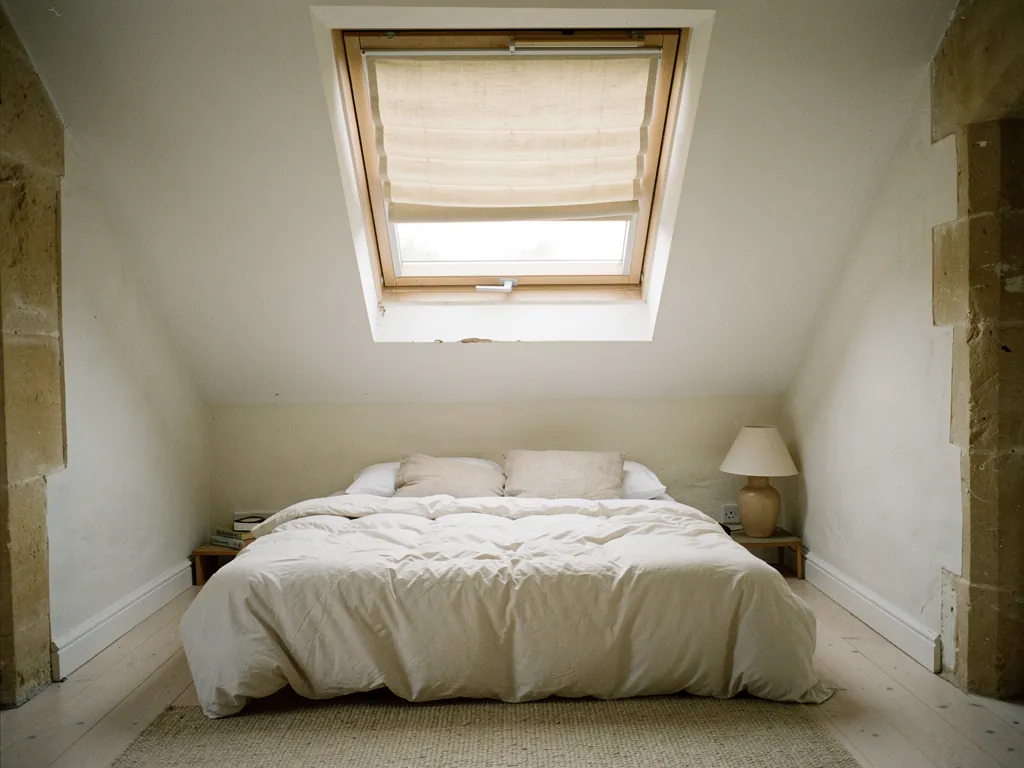
Pick a loft bedroom with a roof window at the head of the bed. In June the sun rises early and the glass is only a few feet from the pillow. In August the same slope can get hot by lunchtime. Neither problem is solved by the window itself, but both are handled well by the right blind, and an opening window adds a third job: the blind has to work with the sash, not against it.
So treat the blind as a component, not an afterthought. It decides how dark the room goes, how much heat reaches the glass and whether the sash can be opened without taking something down. Choosing it along with the window is simpler and usually neater than adding it later.
- Internal blind a blind fixed inside the room, in channels along the sash frame
- Awning blind an external blind that shades the glass from outside
- Roller shutter an external shutter that closes over the glass for shade and darkness
- Insect screen a fine net that lets air through an open sash and keeps flies out
Choosing an internal blind
Inside, the choice is between how dark the room should go and how the blind looks. Most bedrooms want to be dark on a summer morning, while a kitchen or landing wants soft light without glare.
| Type | Effect | Suits |
|---|---|---|
| Blackout | Blocks nearly all daylight | Bedrooms, nurseries |
| Light-filtering | Softens the sun, keeps the view of the sky | Kitchens, offices |
| Pleated | Stops at any height, adjusts from either end | Bathrooms, landings |
| Roller | Plain and simple, in many colours | Any room |
Blackout is the obvious choice for sleeping, but pair it with ventilation. A closed blind on a closed window makes a warm room warmer. If the window can sit in a vent position or with a vent bar for overnight air, the blind can stay down while air still moves.
Colour has a small but real effect. A pale, reflective outer face on the blind sends some of the sun back out through the glass. A dark face soaks it up. In a loft that gets hot, choose the pale one.
The blind is made for a particular window code, because the channels along the frame have to match the sash. Read the plate first. Our guide to VELUX size codes explains how, and it is the first thing we check at the survey.
Awnings and shutters for heat
An internal blind keeps the light out, but the heat has already come through the glass by then. For slopes that face south or west, the better answer is to stop the sun before it hits the window. That is what an external awning blind or roller shutter does.
An awning sits outside, above the glass, and covers it from the sun. A roller shutter closes over the window altogether, which also helps darken a bedroom and gives some extra shade. Both are made to the window size, so the code matters again.
Because they are outside, they need to be fitted at roof level. The simplest time is when the window itself is going in, with scaffold or access already arranged and the roof open. Adding one later means working at height again. We say at the survey whether your roof makes that simple or involved.
Powered versions work from a switch or remote, like the windows described in our guide to VELUX INTEGRA. A manual awning is worked by a pole from inside the room, which is fine for a window you can reach and awkward for one you cannot. If the window is out of reach, choose a powered blind or a window that closes itself.
Accessories that help an opening window
An opening window brings its own small accessories. Most are simple and sensible, and a few are the difference between an opening that gets used and one that does not.
Insect screens
A fine net across the opening lets air through and keeps wasps and flies out. It matters most in a loft bedroom on a summer night, with the window in a vent position. Check that the screen and the blind can work together.
Poles and handles
A manual window set high needs a way to reach the handle. A pole is the cheapest answer and a motor is the neatest. Consider the person using the room. A pole that a child or an older relative cannot manage is a reason to look at electric.
Vent bars and vent positions
A vent bar holds the sash open a little, giving a trickle of air with the window almost closed. It suits overnight use in a bedroom or a bathroom, and a night latch keeps it from swinging wider.
Flashing kits
Not strictly an accessory, but listed for completeness: the flashing makes the join with the roof covering weathertight, and it is chosen for slate, plain tile, profiled tile or Pennant stone. We choose it for your roof and include it on the quote.
Matching extras to the window you have
Not every blind fits every window. The match depends on the size, the age of the window and the type of sash, and a mistake means sending a blind back. A short routine gets it right the first time.
- Read the code on the data plate and photograph the whole plate.
- Note whether the sash opens manually, electrically or by solar power.
- Look at how the sash swings: from a middle hinge or from the top edge.
- Decide whether the blind should be hand-operated or powered.
- Tell us the room and the slope direction.
Hand that to us and we can say what fits. For older windows, we may recommend swapping the window rather than hunting for a blind that fits an out-of-date sash. A whole new window, frame and glass, goes through Building Control and we file that for you, so the swap stays tidy. If you are weighing it up, our guide to how long VELUX windows last helps with the timing.
Any blind of roughly the right size will do.
Blinds run in channels fixed to the sash frame, so they are made for a specific window code. A near miss either does not fit or leaves gaps for light and heat.
Fitting, wiring and neat finishes
Blinds and extras are best planned with the window. A powered blind needs a supply or a battery, and the wiring route is simplest when walls and ceilings are open. Solar-powered blinds need no cable, and are the usual choice in a finished room.
Plan where the controls go. A blind and a window worked by one remote is tidy. Two remotes in a drawer is not. If you have a stairwell window and a landing blind, a wall pad by the stair head handles both. We lay out the controls on the quote so you can see which units share a pad.
Fitting is quick compared with the window itself. A blind clips into its channels. An awning is fixed outside the frame with the flashing and tested. A roller shutter is fixed and sealed in the same way. One team does the lot, the roof is weathertight by the end of the day, and your floors are covered while we work.
For a sense of what these extras add to a job, see the guide to VELUX window fitting cost. Each accessory gets its own priced line on the written quote, so nothing is bundled out of sight.
Putting a package together
With the parts understood, a package becomes easier to see. The shape depends on the room and the slope, so here are three typical ones. They are examples, not fixed bundles.
A loft bedroom facing south. A roof window with an external awning, a blackout blind inside and an insect screen. The awning stops heat, the blind helps sleep and the screen lets air through at night.
A landing under a north slope. A tall, narrow roof window that opens, with a light-filtering blind. There is little heat to block, so the money goes on the opener and the control.
A bathroom at the back of a Georgian house in Clifton. A conservation-style window may be right if the roof is in a conservation area. Choices are narrower there, and the accessories need to suit the slim frame. Our page on conservation rooflights explains the options.
In each case, you can compare opening and fixed choices on the quote, along with the blind that goes with each. The VELUX window installation hub brings the whole range together, and back on that page you can compare every guide in the set, and the costs page sets out broad UK ranges. We visit you, so there is no showroom to find: a free survey and a written, itemised quote, with no obligation.
Looking after blinds and awnings
Blinds on a roof window live a harder life than curtains. They sit in strong sun, they catch condensation on cold mornings, and a bedroom blind gets pulled up and down every day. A little care keeps them working, and a few habits keep the window itself in good order.
Wipe fabric blinds with a soft cloth and mild soapy water, and let them dry fully before rolling or folding them away. Keep the side channels clear of dust and fluff, because a clogged channel is the usual reason a blind starts to catch. In a bathroom, choose a fabric that tolerates damp, and leave the blind raised for a while after a shower so the glass can dry.
Awnings and shutters take the weather directly. Look at them from the garden once or twice a year, and brush off leaves or moss that gather on the frame. A powered unit should be tested from its control, opening and closing the full travel, so you notice a slow motor before it stops. If the glass behind a blind starts to mist between the panes, the sealed unit has failed, and we replace the sealed unit, as set out under misted and failed rooflights.
Blinds also wear out sooner than frames do. Fabric fades, cords fray and motors age. Because the blind is made for the window code, a new one can be ordered from the plate, and the old one comes off in minutes. Keep a photograph of the plate with your household papers, and a replacement is a simple job. The work on the window itself is covered by the 10-year workmanship guarantee described on our guarantee page, which applies to our fitting.
When a window and its blind come to the end of their useful lives at the same time, that is the neat moment to replace both together. The new frame, new flashing and new blind then all share the same date, and the roof is only opened once. The wider set of guides sits on the VELUX window installation page.
Blind and awning questions from loft owners
Can I put a blind on a window I already own?
Often yes, if the window is a current enough type and we can read its code. Send us a photograph of the data plate and we can tell you whether a matching blind exists.
Do I need a blackout blind if I choose an awning?
They do different jobs. An awning stops heat from outside, while a blackout blind darkens the room. For a bedroom you may want both. For a landing, the awning alone may do.
Will a blind get in the way of opening the sash?
Blinds are designed to run beside the sash and let it move. The blind has to match the window, which is why the size code matters. Where you want a vent position, tell us and we will check the pairing.
Tell us about the room
A few details is all we need. We'll come out, advise and give you a written quote.
No pressure, no obligation.