Guide · Sun Tunnels · 8 min read
Sun Tunnel or Rooflight: Which Suits a Dark Room?
A dark room can be fixed two ways from the roof. A sun tunnel carries daylight down a reflective tube to a ceiling disc. A rooflight or roof window is a real pane of glass, and it can open. This guide sets the two against each other, room by room, so the choice follows the room and the roof rather than the brochure.
Two ways to put daylight into a dark room
Every dark room has the same complaint: the light switch is on at noon. What differs is the cure. A sun tunnel and a rooflight both start on the roof, and both end in a brighter room, but they get there by quite different routes.
A sun tunnel is a small clear dome on the roof joined to a mirror-lined tube. The tube runs down through the loft to a diffuser, a round frosted or prismatic disc fixed in the ceiling. The room gets a soft pool of daylight and no view. A rooflight, or a roof window on a pitched slope, is an actual window in the roof. You see sky through it, you can put a blind on it, and if it is an opening model you can air the room through it.
People searching for a tubular skylight vs skylight comparison are usually standing in one of three rooms: a bathroom with no outside wall, a landing that runs back from the stairs, or a hallway in the middle of a terrace. In all three the ceiling is the only place light can come from, and the question is how much of the ceiling and the loft you are willing to give up for it.
- Dome the clear cap outside that catches the sky
- Diffuser the ceiling disc that spreads tube light around
- Roof window an opening window built into a sloping roof
- Rooflight glazing sitting proud of a flat roof
Neither is better in the abstract. A sun tunnel can be the right answer to a windowless bathroom that sits below a full loft, and a roof window is the right answer to a loft bedroom that needs both daylight and a way to cool down. The sections below look at what the room feels like, what the roof allows, what happens in summer and winter, and what the survey checks.
The two side by side
A quick comparison helps before the detail. It is not a scoring system, only a map of where the differences sit.
| Question | Sun tunnel | Rooflight or roof window |
|---|---|---|
| What you see | A glowing disc | Sky, clouds, branches |
| Opens for air | Only with a vent kit | Yes, on opening models |
| Opening in the ceiling | Small and round | Window-sized, with a lined shaft |
| Needs a straight path | Yes, or a bend | Directly above the room |
| Fits under a floor above | Yes, through the loft | No |
| Best for | Inner rooms | Rooms with a roof overhead |
The row that settles many jobs is the fifth. A room with another floor, or a loft conversion, directly above it cannot take a rooflight at all, because there is no roof to put it in. A tube can pass beside a loft room, across a cold loft space and down to the ceiling of the room below, and that is the whole case for the sun tunnel in a nutshell.
The second row matters almost as much. If the room also needs airing, a bathroom especially, a window that opens is the simplest tool. A sun tunnel can still do it, with a ventilation kit fitted into the diffuser, but that adds a fan and a small cost where a roof window would have done it with a handle.
Where a sun tunnel is the better answer
A sun tunnel earns its place where the room has no roof of its own. Think of the shower room at the heart of a 1930s semi, tucked between two bedrooms, or the landing in a Bishopston terrace that runs back from the front door with nothing at the far end. These rooms rely on a bulb all day. A tube can reach them from the nearest stretch of roof, and the opening it needs in the ceiling is a small round hole rather than a window-sized shaft.
It is also the lighter job. There is no plastering of a deep lining, no change to the roof structure beyond a single trimmed opening, and no new window to dress with blinds. For a house where the loft is cold and used for storage, a tube simply crosses it. The sun tunnel installation page lays out the practical sequence, and the same hub holds every question about tubes.
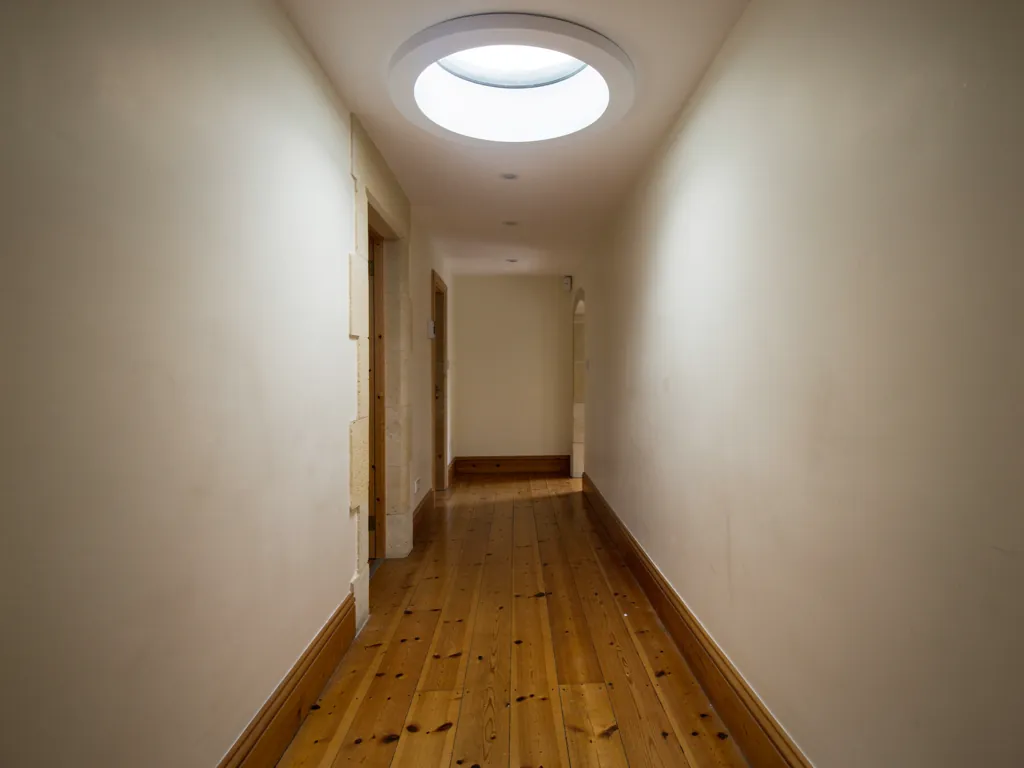
Landings, hallways and utility rooms are the other natural homes. These are rooms where nobody sits and looks out. What they need is brightness at the moment you walk through, and a sun tunnel gives that without asking the roof to carry a feature. For the bathroom case in more depth, see sun tunnels for bathrooms.
One more fit: a rear slope that you cannot see from the road. If the house sits in a conservation area, a small dome on a back roof is often easier to live with than a window-sized unit on a visible slope. The council still decides on listed buildings, so check with them early.
Where a rooflight or roof window wins
A rooflight wins wherever the person in the room wants to see out, feel the room breathe, or use it for more than passing through. A loft bedroom, a study under the slates, a top landing with a stairwell below it: these all ask for something a tube cannot give.
Air is the first reason. A roof window that tilts open at the top lets the warmest, stalest air leave the room, and an electric or solar model can be worked from a wall switch or a handset, and a sensor shuts it if rain starts. Our fresh air rooflights page covers how that works across a house. A sun tunnel, being a closed tube, cannot do this without a fan.
View is the second. A kitchen extension with a roof lantern or flat rooflight gives you sky above the table, which is a different pleasure from a bright ceiling disc. The flat roof rooflights and roof lanterns pages show the range for a flat-roofed room. A pitched loft takes roof windows, and the VELUX windows page covers the common sizes.
A sun tunnel is just a cheaper rooflight.
They do different jobs. A sun tunnel gives diffused daylight to a room with no roof above it. A rooflight gives daylight, a view and, if it opens, air. Choose by the room, not by the price.
Volume of light is the third. A window-sized pane will usually deliver more daylight to a room than a tube of ordinary width. If the room is large and you want it properly bright, a rooflight is the stronger tool. If the room is small and dim, a tube can be plenty.
Let the roof and the loft decide
Before comparing anything else, look up. What is directly above the room decides more than any preference does.
- A pitched roof with the room directly beneath it: roof window or tube, both possible.
- A flat roof directly above: flat rooflight, lantern or tube, all possible.
- A loft room, or another floor, above: tube only.
- A long, shaded or north-facing slope: either still works, because both gather daylight from the whole sky, not only the sun.
For a pitched slate roof on a Victorian terrace, a roof window needs rafters spaced to take it, and every maker sets a minimum pitch. Our guide to the rigid or flexible tube choice explains how a tube deals with the same roof: a rigid pipe wants a straight drop, and a flexible one can wander round a purlin or a water tank.
On a flat roof, the roof build up counts. A sun tunnel on a flat roof sits on a raised kerb that is formed on site, and the flat roof sun tunnel page walks through it. A flat rooflight uses a kerb as well, but a bigger one. Either way the roof is sealed against rain before we leave each evening.
Heat, glare and the seasons
Daylight brings heat in summer and loses it in winter, whichever unit delivers it. The differences are in degree and in what you can do about them.
A tube has a small glazed area at the dome and a long run of lined pipe in the loft. The question people ask is whether it leaks warmth into a cold loft. The full answer is on do sun tunnels lose heat, and it depends on the tube, the diffuser and how well the run is insulated. A rooflight has a much larger area of glass, so what it does to heat gain and loss is chiefly a matter of glass choice.
When summer comes, a loft roof window facing south or west may heat the room well before the walls do. Solar control glass helps, an external awning blind helps more, and opening the window lets the built-up air out. A sun tunnel is gentler on this score, because its glazing is small and the light arrives spread out over a disc, though a bright south slope still sends a lot down the tube.
Glare is a different matter. A rooflight over a sofa or a screen can dazzle at certain hours, and a blind solves it. A diffuser rarely dazzles at all, since its job is to soften light. That makes a tube a comfortable choice for a hallway you pass through, and a roof window with a blind the comfortable choice for a room you sit in.
Winter is the quieter season for both. A tube still delivers a soft glow on a grey day, only dimmer, while a roof window delivers the thin low sun that a tube sometimes misses. If you want a room that is cheerful in December, either will help more than a bulb.
Costs, rules and the survey visit
Both options are building work in the roof, so both follow the same sensible order: survey, quote, a date, and a roof that is sealed against the weather before we leave each evening. A new opening in a roof is building work. It needs the structure trimmed properly and must meet the regulations, and where the work is notifiable, Building Control hears from us, not from you.
On price, the useful rule is that the tube is usually the smaller job and the rooflight is the larger one, but a tube with a long run, several bends or a ventilation kit can close the gap. Broad UK ranges for each type sit on our costs page and on sun tunnel cost. What moves the price on the day is the roof covering, the length of the run, and whether anything needs to open.
On planning, rooflights are usually permitted development in England if they sit no more than 150mm above the slope and stay below the highest part of the roof, though a flat, a listed house or a street under an Article 4 direction is treated differently. The planning permission answer sets out the limits. For a house in Bath or in Clifton, check with the council before anything is ordered.
Booking the survey is free and binds you to no order. We look at the room, stand in the loft, trace the path a tube could take and note where a window could go. The written, itemised quote shows both options where both work, with opening choices listed for each, so you can set a tube and a roof window next to each other and see what each would cost and give. The wider sun tunnel range is on the hub, and our guarantee covers the workmanship for ten years either way.
Tube or window: what people ask once they have both on the list
Will a sun tunnel make a windowless room as bright as a window would?
Not usually. A tube gives a steady, soft light that is far better than a bulb on a bright day, but a full-size window delivers a larger quantity and a view. We explain what to expect for your room at the survey, based on the roof and the length of the run.
Can I have a sun tunnel in one room and a roof window in another?
Yes, and it is a sensible mix. A tube suits the inner landing or bathroom below a floor, and a roof window suits the loft bedroom or top landing where air matters. We quote them together when both are wanted.
Is a sun tunnel easier to fit than a rooflight?
Often, because the opening in the roof and the ceiling is small and round. The run through the loft can add work, and the roof still needs the same care. We give a clear time and price for each at the survey.

Tell us about the room
A few details is all we need. We'll come out, advise and give you a written quote.
No pressure, no obligation.