Guide · Misted Rooflights Replaced · 8 min read
Why Rooflight Glass Mists Between the Panes
A rooflight that fogs up between its two sheets of glass has not got dirty and cannot be wiped clear. The sealed unit has lost its seal, and moist air has found its way into the gap. This guide explains how that happens, how to be sure that is what you are looking at, and the sensible ways forward.
What the gap between the panes is for
A modern rooflight or roof window does not hold a single sheet of glass. It holds a sealed unit: two or three panes with a narrow gap between them, joined round the edge by a thin metal or plastic spacer bar and a band of sealant. The gap is filled with dry air or a heavier gas, and the dryness is the point. Dry air in a gap conducts heat poorly, so the unit loses less warmth than a single pane could.
Inside the spacer bar sits a drying agent, a fine granular material that soaks up any trace of moisture that was in the gap on the day the unit was made. It is the reason a new unit stays clear for a long time, even though it sits in a roof that is warm on one side and cold on the other every single day.
So when we talk about misted rooflight glass, we mean something specific: moisture inside the sealed gap, where no cloth can reach. It is a fault in the unit itself, not in the room around it.
A roof is a hard place for a seal. It faces the sky all day, takes the sun on one pane while the other pane stays cool, and gets rained on from above. Those swings in temperature make the glass and the spacer move very slightly, again and again. Eventually the sealant at one corner can part from the glass, and the gap is no longer closed.
How moisture gets in and why it shows
Once the edge seal has opened, even by a hair, air from outside can move into the gap. On a cold night the air in the gap cools, its pressure falls, and the unit effectively breathes in. Damp air comes with it. On a warm day the gas expands and some of it leaves again, but the moisture tends to stay behind.
The drying agent copes with this for a while. It takes in the moisture and holds it. Then it fills up, and from that point any new moisture has nowhere to go. It condenses on the coldest surface it can find, which is the inner face of the outer pane. You see a grey haze, then droplets, then a tide mark as the water dries and runs.
- Sealed unit the glass sandwich itself, two or three panes bonded round the edge
- Spacer bar the thin strip that holds the panes apart and carries the drying agent
- Desiccant the granules inside the bar that absorb moisture from the gap
- Edge seal the sealant band round the rim that keeps the gap closed
That sequence explains why the first sign is often partial. A haze may appear on a damp morning and disappear by lunchtime, which makes people think the glass has cleared itself. It has not. The drying agent is still coping, just, and it will give up in one wet week.
It also explains why misting tends to start at an edge or corner. The seal usually opens where the unit sits lowest, where water collects on the frame, or where the sun has worked the sealant hardest. A fine line of cloud creeping in from one side is a very typical early picture.
Misted glass or ordinary condensation
Not every damp window is a failed one. A roof window gathers condensation on its room side when warm, moist air meets cold glass, which happens in a bathroom after a shower or a bedroom on a winter morning. That is the room telling you it needs more air, not the unit failing. The table sets out how to tell the three cases apart.
| Where the mist sits | Wipes off? | What it means |
|---|---|---|
| Room side of the glass | Yes, from indoors | Condensation from the room |
| Outside face of the glass | Yes, from outside | Dew or rain, nothing wrong |
| Between the two panes | No, from either side | Sealed unit has failed |
The simplest check is a dry cloth on the inside face, then a look from outside if you can do so safely from a window or the ground. Do not climb onto a roof for it. If the mist sits behind the glass in both cases, it is inside the unit.
Misting between the panes just needs the window to dry out.
The gap is sealed, so it cannot dry out on its own. Once the drying agent is full, the moisture comes and goes with the weather but never leaves.
If the glass is clear in some weather and cloudy in others, that is still a failed seal in its early stage. Our guide to the signs of a failed rooflight covers the other symptoms worth looking for, including ones that have nothing to do with fog.
Does it matter if the glass stays misted
A misted unit does not usually cause a sudden problem. Water does not pour in, and the rooflight carries on keeping the weather out, because the failure is inside the glass sandwich and not at the frame or the flashing. The consequences are quieter.
The first is the view. A hazy or streaked pane takes the point out of a rooflight, which is there to show sky. Over a bed or a landing, that dull area is the thing you look at every morning.
The second is performance. Once the gap holds damp air instead of dry, the unit insulates less well than it did. The gas fill, if there was one, escapes through the same opening that let the moisture in. A room under a roof depends on its glazing for comfort in both seasons, so a unit that has lost its seal will feel colder in winter and give up warmth faster.
The third is the slow one. Moisture that stays in the gap can mark the glass coatings and leave deposits that no longer wash away. A unit that has been misted for a long time can be permanently stained, and the seal itself cannot be closed again in any lasting way.
There is also a regulations angle worth knowing. Replacing the whole rooflight is notifiable building work, and it has to meet the thermal limits in Part L 2021. A new sealed unit in the same frame generally is not notifiable. More on that in the guide to rooflight glass and building regulations.
Your options when the glass has misted
There are only really two sensible routes, and which one fits depends on the frame around the glass, not the glass itself.
Replace the sealed unit. If the frame is square, sound and sits well in the roof, a new glass unit can be made to the same size and fitted into the existing frame. This keeps the work small. The roof is open for a short time, the room is protected, and the visible change is clear glass. It suits a roof window in good order and a flat rooflight whose kerb and frame are still sound. Our misted and failed rooflights hub lists every route, and the page on rooflight sealed unit replacement sets out the decision in full.
Replace the whole unit. If the frame is warped, rotted, corroded or past its best, a new glass unit simply sits in a tired frame. In that case it makes more sense to replace the rooflight or roof window altogether, frame, flashing and glass, and to meet today's thermal limits at the same time. It also gives a chance to choose an opening unit where the old one was fixed.
- Frame straight and the opening mechanism smooth: look at the glass unit alone.
- Frame soft, split or stained at the joints: look at the whole rooflight.
- Old unit that never opened and the room is stuffy: consider a new opening one.
Where the unit is a VELUX roof window, the maker's size code is printed on a plate inside the frame, which makes matching a new glass unit simple. We cover that in replacing the glass in a VELUX window.
Whichever route suits, you start with a free survey, and the written quote itemises each choice with no obligation to proceed. It shows both options side by side where both are possible, so you can see what each costs before you decide.
Is it worth acting now
Because a misted unit is rarely urgent, many people leave it. That is a reasonable choice for a while, particularly in a loft you rarely use. But a few points tip the balance towards acting sooner.
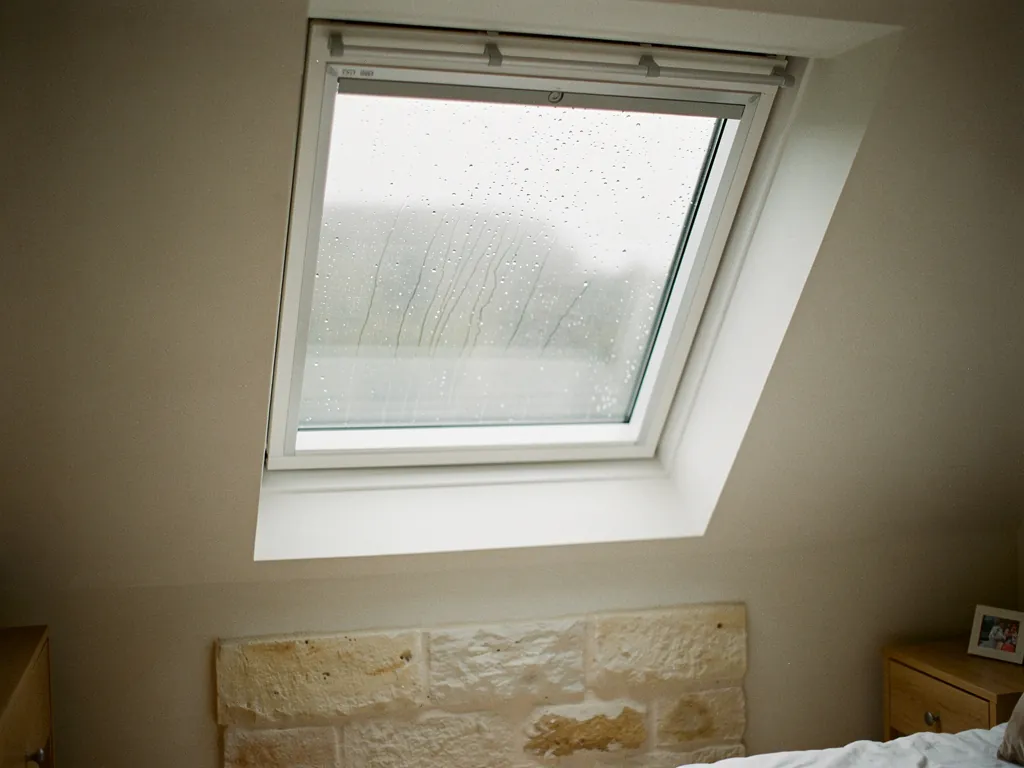
If the room is a bedroom or a bathroom, the view and the warmth matter every day. If the haze has spread beyond one corner, the seal has probably gone all the way round. If you are planning other work on the roof, such as a loft conversion or a new covering, replacing the glass beforehand costs less than scaffolding a second time.
Age counts too. A unit that has failed in one place was made at the same time as its neighbours, and the others on the roof have lived through the same weather. If one has misted, it is fair to look at the rest and think about replacing them together, with one visit and one tidy-up.
There is a fuller look at the decision in is a misted rooflight worth replacing, and the guide to how long a rooflight sealed unit lasts explains what to expect from a new one. Typical prices for this sort of glazing work, and what moves them, are on the costs page.
For the full picture of what we do across Bristol, Bath and the towns around them, the hub page on misted and failed rooflights replaced is the place to start.
What happens on the day we replace it
Knowing what the visit looks like removes most of the worry. The job is small enough that one team does it from start to finish, and the opening is closed in and weathertight each evening.
- We lay protection over floors and furniture below the unit.
- We take out the failed glass, or the whole unit if that is the plan.
- The new unit goes in, set square and checked against the opening.
- We test the opening action, if it has one, and clean the glass both sides.
- Everything is cleared away and the roof is sound before we leave.
If the job is a whole new rooflight, we deal with the Building Control notification, since that work is notifiable, and the finished work carries our 10-year workmanship guarantee. You can read what that covers on the guarantee page.
A replacement is also the moment to think about air. An old fixed unit can be swapped for one that opens, and our fresh air rooflights page shows what is possible. Each quote shows the opening options, and a fixed unit stays a perfectly good answer where it suits the room.
If you are in Bristol, Bath or any of the towns around them, the areas page shows where we work. Book a free survey and we will look at the unit, the frame and the roof, tell you plainly which way we would go, and leave the decision with you.
Misted glass: what homeowners ask once they have spotted it
Will the mist between my rooflight panes clear on its own?
It can look as though it does, because a damp morning shows more than a dry afternoon. But the gap is sealed and the drying agent is full, so the moisture only moves about. A cloudy unit stays cloudy, and replacing the sealed unit is how it comes clear.
Does misted glass mean my roof is letting water in?
Not by itself. The fault is in the glass sandwich, not in the flashing or the frame joint. If you also see drips, staining on the ceiling or a damp stain under the unit, that is a separate matter and we would look at it at the survey.
Is a misted skylight covered by anything?
That depends on the maker's terms and the age of the unit, so check any paperwork from when it was fitted. We can look at the data plate and the glass at a free survey and tell you what we see.

Tell us about the room
A few details is all we need. We'll come out, advise and give you a written quote.
No pressure, no obligation.